The History of Mutual Funds


The concept of Mutual Funds is rooted in the principles of diversification and professional management, allowing individual investors to access a broad range of assets and seek individual security risk and market risk reduction through collective investment.
This industry has played a vital role in democratising investment avenues, aiding various kinds of people to benefit from the growth of businesses and economies worldwide.
The first ever Mutual Fund: Eendragt Maakt Magt
18th-century Amsterdam was a bustling financial hub where a visionary merchant named Adriaan Van Ketwich laid the groundwork for what would become the modern Mutual Fund.
In 1774, Van Ketwich recognised the challenges individual investors encountered in diversifying their investments. To address this, he introduced the world’s first recorded Mutual Fund, named ‘Eendragt Maakt Magt’, which translates to ‘Unity Creates Strength’.

This fund was designed with several innovative features, which may be considered the fundamentals of today’s Mutual Funds as well:
1) Diversification: To reduce risk, Van Ketwich invested the money in a diverse array of bonds, issued by various European governments and colonies. This minimised the risk associated with geo-political and economic instability.
2) Regular Income Stream: The fund paid dividends to shareholders, which provided them with a steady income stream in the uncertain economic climate of the 18th century.
3) Professional Management: Van Ketwich and his team actively managed the portfolio, where they leveraged their expertise and knowledge of the financial markets.
4) Transparency: Van Ketwich also implemented a set of rules to ensure transparency and fairness, which included regular reporting to investors and a clear outline of the fund’s investment strategy.
Mutual Funds and the world’s superpower: The United States of America
The development of Mutual Funds in the USA began with the establishment of the ‘Massachusetts Investors Trust’ in 1924, which is often recognised as the first modern Mutual Fund, offering an open-ended structure.
These open-ended funds had no fixed maturity period and allowed investors to buy and sell their units at any time. This advanced structure provided greater flexibility and liquidity to investors, which laid the foundation for the rapid growth of the Mutual Fund industry in the USA.
The expansion of Mutual Funds to the rest of the world
Driven by economic development, increasing investor demand, and the adoption of global investment practices, Mutual Funds began to gain traction outside of the USA and Europe from the 1950s onwards.
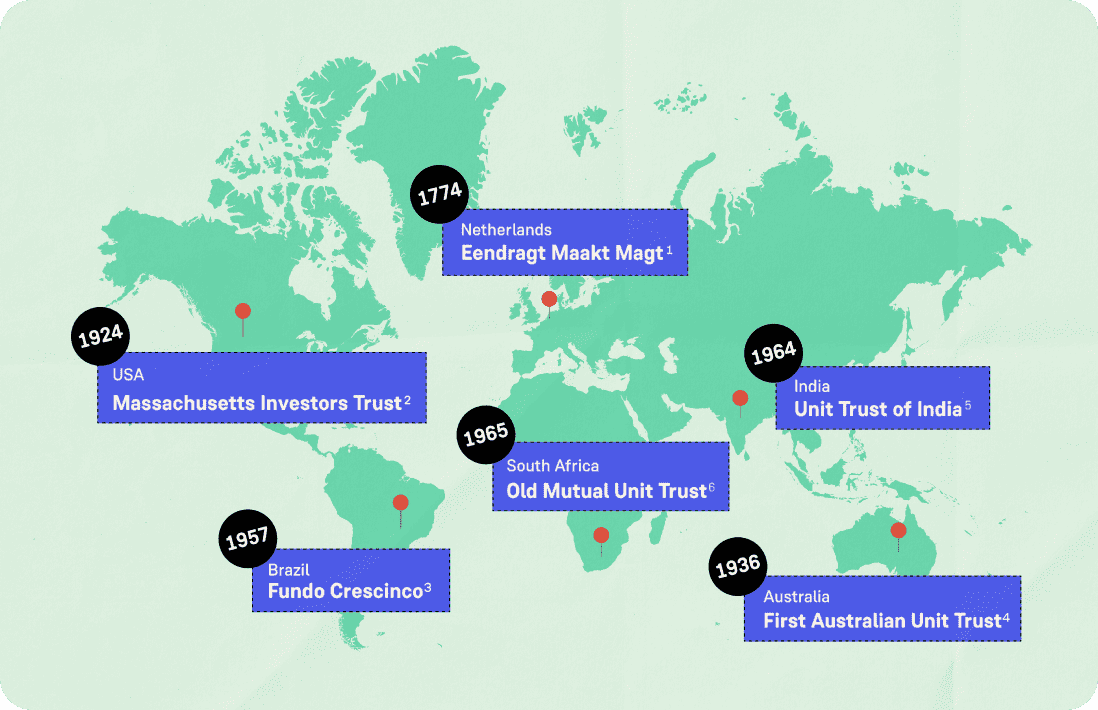
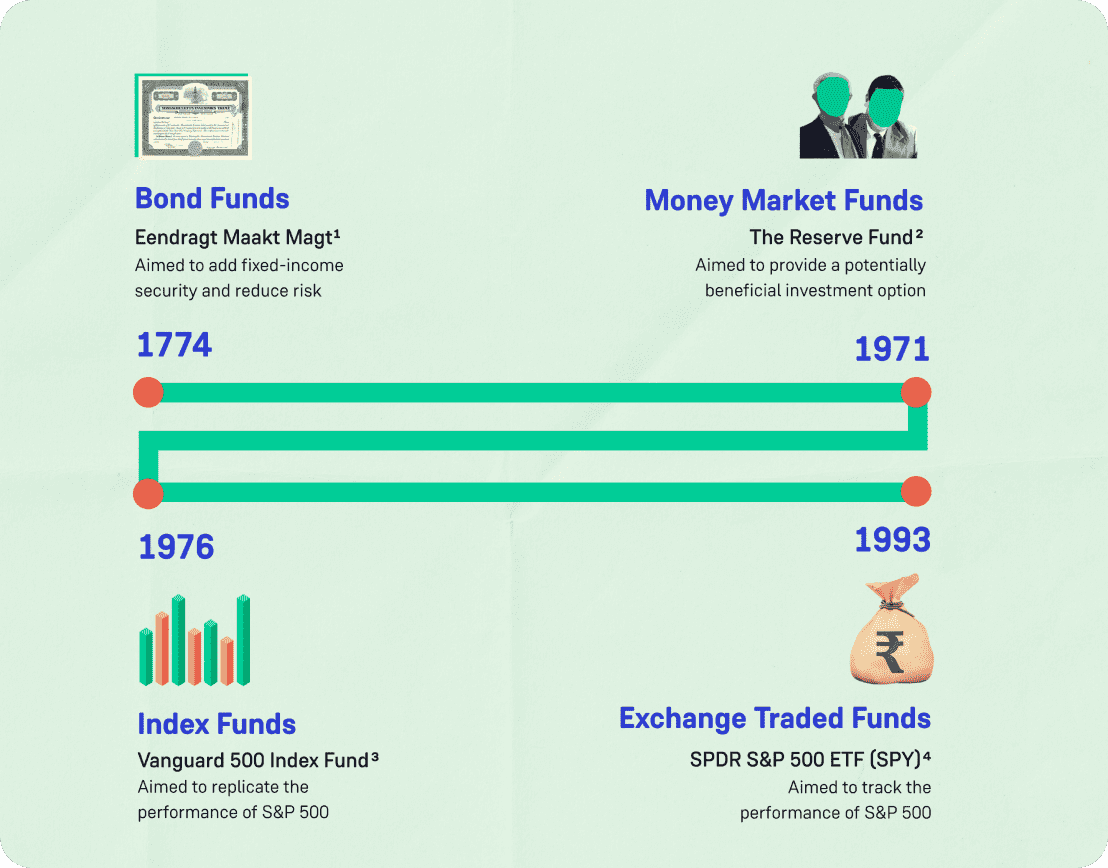
The investment boom in the 1960s and 1970s led to the creation of more complex products, each based on different investment principles.
The introduction of Index Funds by Vanguard and SPDR S&P 500 ETF revolutionized the industry with low-cost offerings and passive investment options.
Era of crisis: The 1990s and 2000s
The 1990s and 2000s were marked by several significant financial crises, such as the Asian Financial Crisis in 1997, the Russian Financial Crisis in 1998, the Dot-Com Bubble in 2000, and the Global Financial Crisis in 2007.
These had a profound impact on the global economy and the Mutual Fund industry.
For example, during the Dot-Com Bubble, equity funds experienced substantial losses, while bond funds, which invested in high-quality government and corporate bonds, saw increased demand as they served as a potentially more cautious alternative.
Additionally, the rise of ETFs and Index Funds offered lower-cost and more flexible investment options. This further revitalized the industry and made Mutual Funds “one of” the preferred investment choices for many, a preference that continues to date.